Quick Summary & Key Takeaways
- Unified Identity: Brand consistency in social media design requires a strict, documented visual identity system applied universally across all digital touchpoints.
- Standardized Systems: By locking in your typography scale, color palette, and grid layouts, your branding becomes instantly recognizable, bypassing cognitive friction.
- Scalable Execution: Utilizing bespoke Canva template design empowers marketing teams to publish high-volume content without violating brand governance rules.
- Omnichannel Trust: A consistent aesthetic across Instagram, LinkedIn, and YouTube significantly accelerates audience trust and boosts lead generation.
What Is Brand Consistency in Social Media Design?
Brand consistency in social media design is the strategic practice of delivering uniform visual, tonal, and thematic messaging across all content marketing channels. It ensures that a YouTube thumbnail, an Instagram carousel, a website banner, and a LinkedIn document post all undeniably belong to the exact same corporate entity. It is the visual manifestation of reliability.
Why Is Brand Consistency Essential for Lead Generation?
Brand consistency is a compounding financial asset. When a prospect navigates from a highly professional LinkedIn profile to a chaotic, off-brand Instagram feed, disjointed visuals cause subconscious cognitive friction. Consistent marketing creatives engineer a seamless psychological journey. Extensive usability research proves that strict brand governance directly increases brand awareness, engagement, and ultimately, conversion rates by reducing the time it takes to build customer trust.
The InfiGraphyx Omnichannel Identity Framework
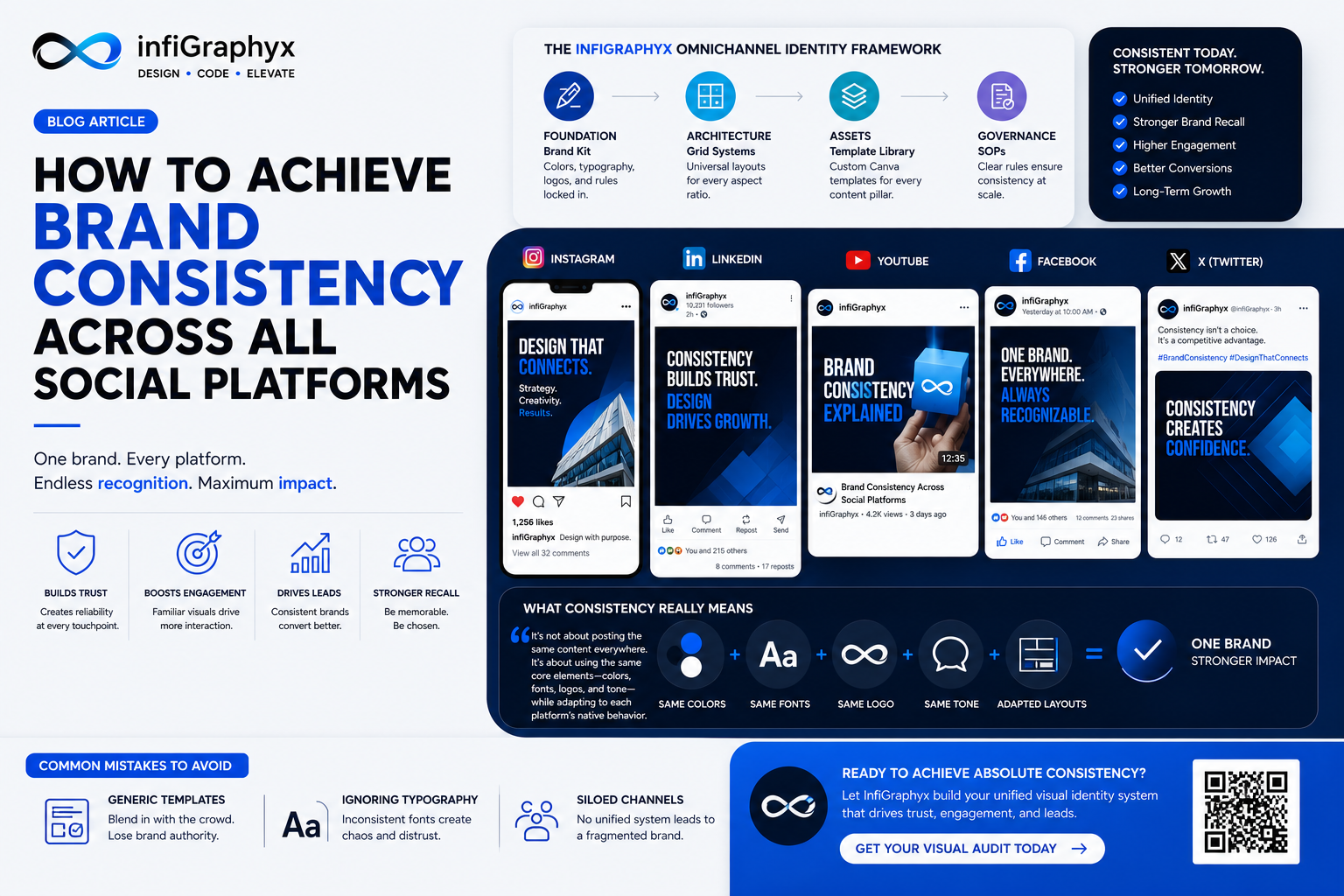
To establish an unbreakable visual presence, deploy the proprietary InfiGraphyx Omnichannel Identity Framework:
- The Foundation (Brand Kit): Locking in primary/secondary HEX codes, font files, and logo clearance rules.
- The Architecture (Grid Systems): Establishing universal margins, padding, and layout rules for various aspect ratios (1:1, 4:5, 16:9).
- The Assets (Template Library): Building custom Canva templates for specific content pillars (Education, Proof, Promotion).
- The Governance (SOPs): Documenting exactly how and when to use specific assets to prevent "DIY dilution" by internal teams.
Best Practices for Building a Visual Identity System
1. Document Your Brand Guidelines Rigidly
A logo is not a brand. You must document strict rules regarding exact color codes, typographic hierarchy (H1, H2, body), and photographic tone. This documentation acts as the source of truth for all internal staff and external creators.
2. Develop Platform-Specific Core Templates
Instead of designing from scratch daily, develop a robust library of reusable layout frameworks: Educational carousels, Quote graphics, and Promotional banners.
3. Master Cross-Platform Adaptation
Consistency is recognizable adaptation, not identical copying. A LinkedIn graphic requires a more professional, text-dense structure than an Instagram post, but both must utilize the exact same primary brand color, font family, and CTA styling to maintain the semantic connection.
4. Standardize Imagery and Iconography
Ensure all vectors and icons share the same line weight and style (flat vs. 3D, filled vs. outlined). Apply consistent overlays or filters to all photography.
Expert Insight
Industry best practices highlight that brand consistency does not mean posting the exact same image everywhere. It means the core elements (fonts, colors, logos, tone) remain identical, while the layout and text density adapt to fit the native behavior of each specific platform.
Common Mistakes in Visual Branding
- Relying on Unedited Stock Templates: Using generic Canva templates makes you blend into the noise and destroys brand authority. Your templates must be bespoke.
- Ignoring Typography Rules: Switching fonts based on the "vibe" of the day creates a chaotic, untrustworthy feed that repels high-ticket clients.
- Siloed Marketing Channels: Having one team design for YouTube and another for Instagram without a unifying brand governance document.
Achieve Absolute Visual Consistency
Maintaining visual discipline internally is exceptionally challenging for growing teams. Partnering with a dedicated agency ensures your visual identity remains uncompromised. To build a system that drives reliable lead generation, contact InfiGraphyx for a comprehensive visual audit of your current digital footprint.
infiGraphyx Team
The infiGraphyx team consists of talented designers and creative professionals passionate about helping brands succeed through stunning visual content.